Réponse courte
Les bénéfices de trading sont réduits par les coûts de trading tels que le spread, les commissions, les swaps et parfois les fermetures partielles de positions. Même lorsque le prix évolue en votre faveur, ces coûts affectent le résultat final.
Cette vidéo explique les raisons courantes pour lesquelles une transaction rentable peut tout de même générer un bénéfice net inférieur aux attentes, notamment l'impact du spread, des commissions, des frais de swap et des coûts de trading. Elle aide les traders à comprendre comment les coûts réels du marché influencent le résultat final.
Les coûts cachés dans chaque transaction
De nombreux traders se concentrent uniquement sur le mouvement des prix, mais le trading réel comprend des coûts.
Les principaux sont :
- le spread
- la commission (sur certains types de comptes)
- le swap (frais de nuit)
Ce sont des dépenses normales du marché.
Comment le spread affecte votre bénéfice
Lorsque vous ouvrez une transaction :
- L'achat s'ouvre au prix Ask
- La vente s'ouvre au prix Bid
Le spread est appliqué immédiatement.
Cela signifie :
- le prix doit évoluer d'au moins la valeur du spread avant que le bénéfice ne commence
- une partie du mouvement sert à couvrir le coût du spread
Les spreads importants réduisent le bénéfice net de manière plus visible.
Comment les commissions réduisent le bénéfice net
Certains comptes facturent une commission fixe par transaction.
Cette commission :
- est déduite à l'ouverture ou à la fermeture des positions
- réduit votre bénéfice final
- est distincte du spread
Même une transaction rentable affichera un résultat net légèrement inférieur après la commission.
Qu'est-ce que le swap et quand s'applique-t-il
Le swap est des frais de financement de nuit.
Il s'applique lorsque :
- une transaction est maintenue au-delà du rollover de la journée de trading
- selon l'instrument et la direction
Le swap peut être :
- négatif (coût)
- parfois positif (crédit)
La plupart des transactions à court terme évitent le swap, mais les transactions à long terme le ressentent davantage.
Pourquoi les fermetures partielles affectent le bénéfice
Dans certains cas :
- une partie d'une position peut se fermer automatiquement (contrôle des risques ou stop out)
- la position restante continue de fonctionner
Cela réduit la taille globale de la position et le potentiel de bénéfice final.
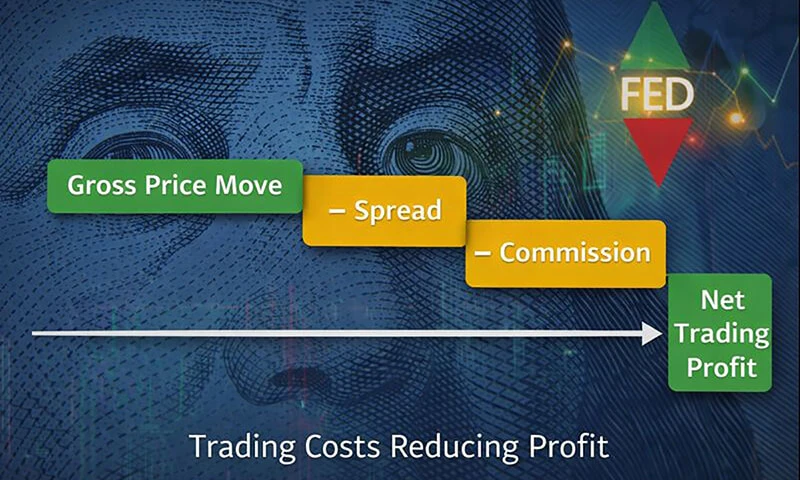
L'illustration montre comment les coûts sont soustraits du mouvement des prix pour former le bénéfice réel du trading.
Pourquoi c'est un comportement normal du marché
Ces coûts ne sont pas des erreurs.
Ils représentent :
✅ l'accès à la liquidité
✅ le service d'exécution
✅ le financement du marché
Tous les marchés professionnels fonctionnent avec des coûts de transaction.
Pourquoi cela est important pour les traders
Comprendre les coûts de trading aide les traders à :
- calculer des objectifs de bénéfice réalistes
- choisir des types de comptes appropriés
- éviter les déceptions
- gérer le risque avec précision
La plupart des problèmes de « bénéfice manquant » proviennent du fait d'ignorer les coûts.
La suite
Maintenant que les coûts sont clairs, le sujet suivant est :
Pourquoi mon niveau de marge a-t-il baissé sans ouvrir de nouvelles transactions ?
Cela relie la perte flottante à la mécanique de la marge.
Revenir en arrière Revenir en arrière