Resposta curta
O nível de margem desce quando o seu capital próprio diminui devido a perdas flutuantes, mesmo que não sejam abertas novas operações. Como o nível de margem é calculado com base no capital próprio, os movimentos de preço do mercado, por si só, podem reduzi-lo.
Este vídeo explica por que motivo o nível de margem pode descer mesmo que não sejam abertas novas operações. Mostra como as perdas flutuantes reduzem o capital próprio, o que reduz automaticamente o nível de margem à medida que os preços de mercado se movem.
O que o nível de margem mede, na realidade
O nível de margem mostra a quantidade de capital próprio que tem em comparação com a margem bloqueada em operações abertas.
Fórmula:
Nível de Margem = (Capital Próprio / Margem) × 100%
Isto significa que:
- o capital próprio muda constantemente com o movimento dos preços
- a margem normalmente permanece fixa enquanto as posições estão abertas
Assim, o nível de margem pode descer mesmo sem abrir nada de novo.
O papel da perda flutuante
A perda flutuante é a perda não realizada em operações abertas.
Quando o preço se move contra a sua posição:
- a perda flutuante aumenta
- o capital próprio diminui
- a margem mantém-se igual
Resultado: o nível de margem desce automaticamente
Esta é a razão mais comum para os traders verem o nível de margem a descer.
Por que motivo a alavancagem faz o nível de margem mudar mais depressa
A alavancagem permite-lhe abrir posições maiores com uma margem menor.
Isto significa que:
- pequenos movimentos de preço criam lucros ou perdas maiores
- o capital próprio muda mais depressa
- o nível de margem torna-se mais sensível
Alavancagem mais elevada = flutuações mais rápidas do nível de margem.
Exemplo em termos simples
Abre uma operação utilizando 1000 $ de margem.
Se o mercado se mover contra si:
- a perda flutuante reduz o capital próprio
- a margem mantém-se em 1000 $
- o nível de margem desce
Não é necessário abrir novas operações para que isto aconteça.
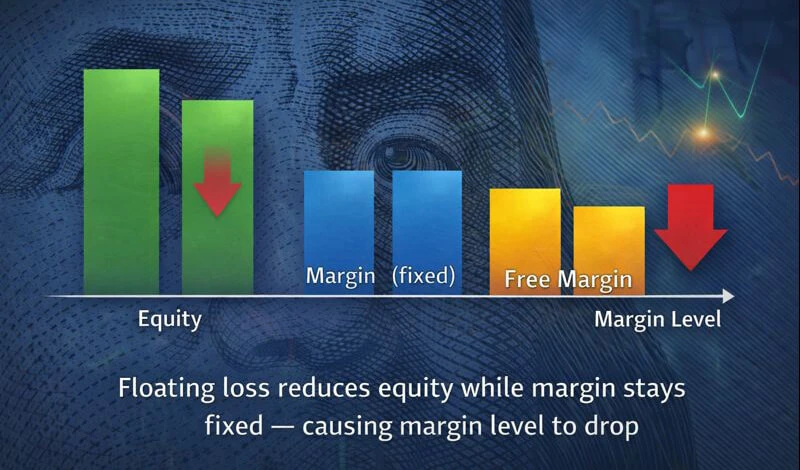
A ilustração mostra como o movimento de preço, por si só, pode reduzir o nível de margem.
Por que motivo isto é um comportamento normal do mercado
Isto não é:
❌ um erro do sistema
❌ uma ação oculta da corretora
❌ um cálculo incorreto
Isto é simplesmente:
✅ controlo de risco em tempo real
✅ o funcionamento da negociação alavancada
✅ a mecânica padrão da margem
Todas as plataformas de negociação funcionam desta forma.
Por que motivo isto é importante para os traders
Compreender o nível de margem ajuda os traders a:
- monitorizar o risco em tempo real
- evitar chamadas de margem inesperadas
- escolher a alavancagem adequada
- gerir corretamente o tamanho das posições
A maioria dos problemas de margem resulta de ignorar o impacto da perda flutuante.
O que se segue
Agora que o comportamento do nível de margem está claro, o próximo tópico é:
Por que motivo não consigo fechar a minha operação exatamente ao preço que vejo no gráfico?
Isto explica a execução de mercado e o slippage (derrapagem) em condições reais.
Voltar Voltar